Door and window sensors tell you someone is already inside. A perimeter beam tells you the moment someone crosses the fence line, the driveway or the yard, while there is still time to react.
How a beam detector works
A beam detector is a pair of units: a transmitter on one side and a receiver on the other. They send invisible infrared beams across the gap. When something blocks the beams, the receiver opens its alarm contact and the alarm panel sees a trip, the same way it sees a door opening.
Where they make sense
Driveway and gate entrances, side yards, along a fence or wall, the back of a warehouse, a storage yard or a parking area after hours. They are a good fit when you want warning before someone reaches the building, and when cameras alone would only record what happened.
Avoiding false alarms
Most false alarms come from leaves, birds or small animals. Dual-beam and quad-beam detectors only trip when the beams are blocked together, which a falling leaf rarely does. Mounting height matters too: high enough that a cat walks under it, low enough that a person cannot step over it.
Choose a unit rated for more distance than the gap you are covering, keep plants trimmed out of the beam path, and avoid aiming the receiver straight into the rising or setting sun.
Wiring it the right way
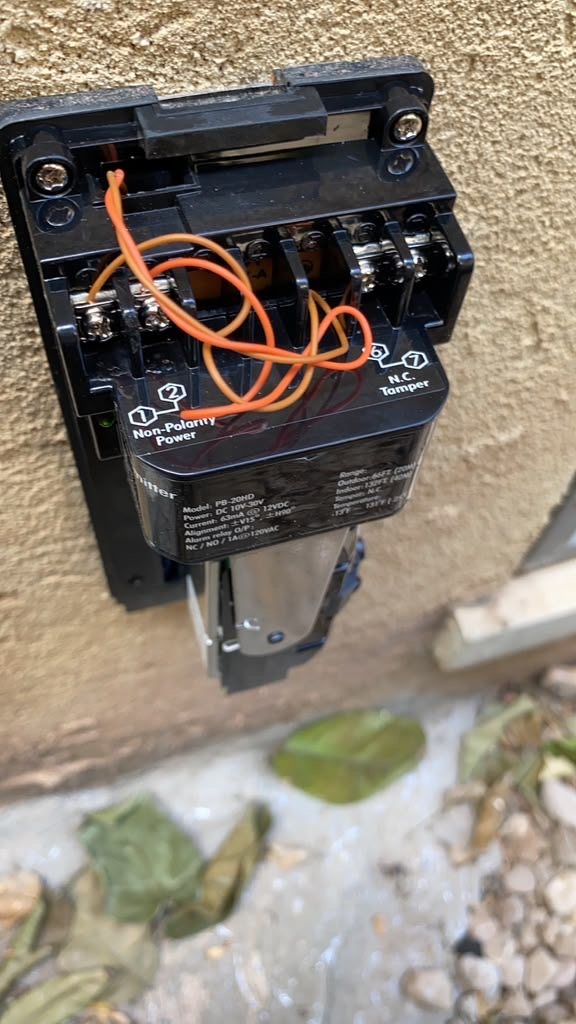
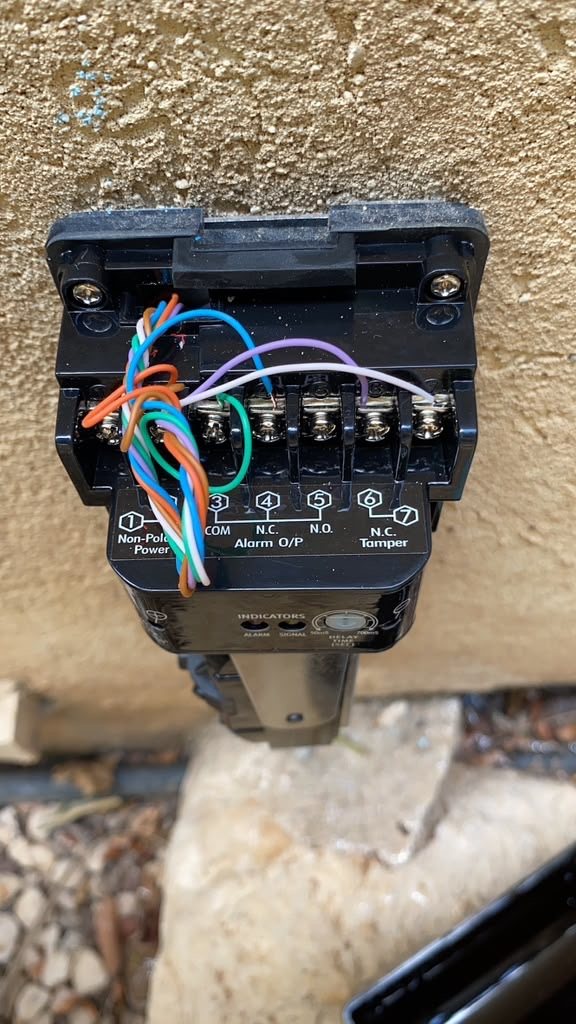
Each detector needs power, an alarm output wired to a zone on the panel, and a tamper circuit wired to a tamper zone, so the panel knows if someone opens the cover. Outdoor cable runs are sealed against water, and the two units are carefully aligned and tested before we leave. The photos on this page show one of our installs, before and after the alarm and tamper wiring.
Pair it with cameras
A beam trip is most useful when a camera is looking at the same spot. When the alarm goes off you open the app and see what crossed the line, instead of guessing.
Related: